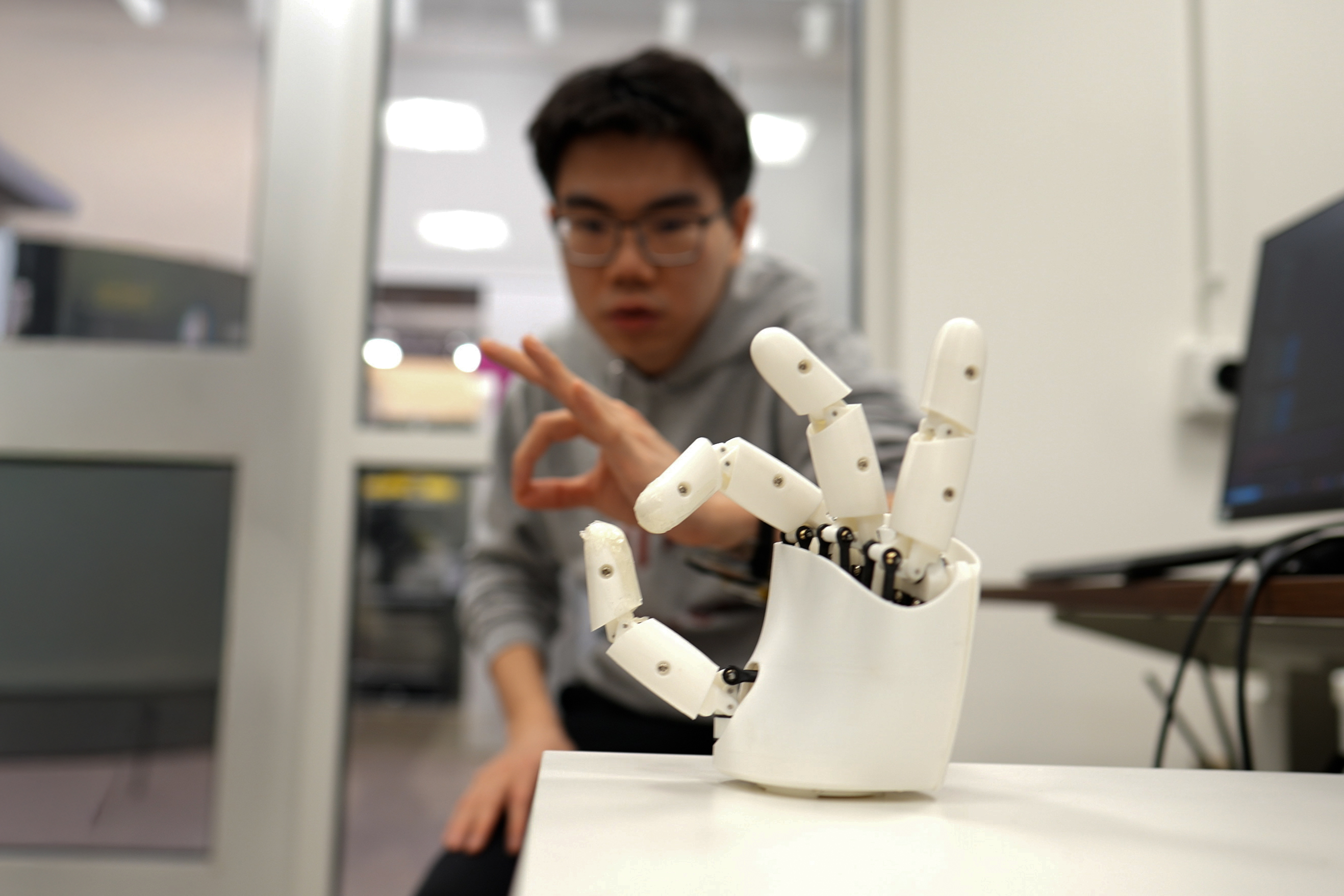
Wristband Enables Wearers to Control a Robotic Hand with Their Own Movements
Revolutionizing Hand Tracking with Ultrasound Technology
Researchers at MIT have created an innovative ultrasound wristband that lets users control robotic hands or interact within virtual environments through natural hand and finger movements. The lightweight device continuously images the muscles, tendons, and ligaments in the wrist as the wearer moves. An AI algorithm interprets these images in real time, translating the data into exact hand positions for use in robotics and computer applications.
How the Wristband Works
The system includes an ultrasound sticker, about the size of a smartwatch, paired with onboard electronics. As wearers form gestures or manipulate objects, the wristband captures detailed muscle activity. The AI then decodes these images, mapping them to up to 22 degrees of freedom in the fingers and palm. This enables high-precision tracking for complex, dexterous tasks.
Demonstrations and Applications
In trials, users wearing the wristband were able to wirelessly control a robotic hand to play a piano, shoot a basketball, and interact with virtual objects on a screen. The wristband also accurately tracked American Sign Language gestures and object interactions like gripping a tennis ball or using scissors.
Future Potential
With ongoing data collection from a wide variety of users, the MIT team aims to create comprehensive motion datasets. These could be valuable for training more dexterous humanoid robots and enhancing AR/VR systems. The researchers are further miniaturizing the hardware and expanding the AI’s gesture repertoire, with hopes of making the wristband a universal tool for intuitive robotic and digital control.
For a detailed look at this research, see the original article on MIT News.