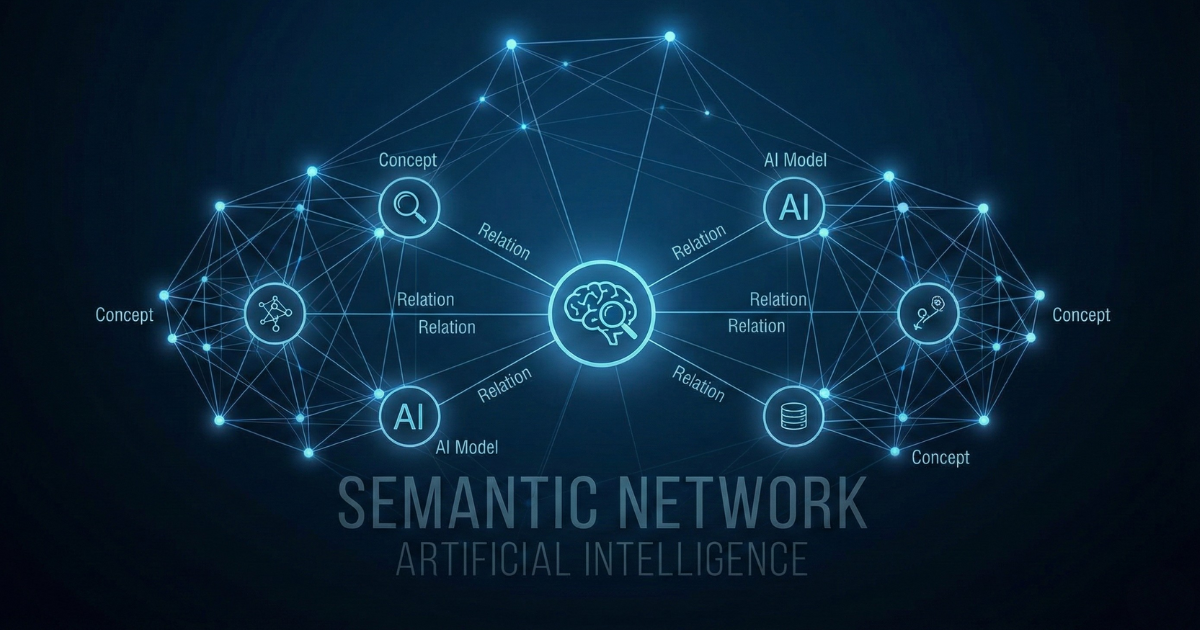
Have you ever wondered how machines understand that a “dog” is an “animal,” or how Google instantly knows what you mean even when you type just one or two words? How does an AI system connect meanings, relationships, and concepts the way a human brain does?
The answer lies in a knowledge-representation method called a semantic network. A semantic network allows machines to store information in a web of connected concepts, helping AI understand not just data, but the relationships behind it. This structured map of knowledge makes it possible for systems to reason, draw conclusions, and process language intelligently—the same way humans connect ideas in their minds.
Semantic Networks in Artificial Intelligence: Structuring Knowledge for Machines
Semantic networks are one of the oldest and most influential methods of knowledge representation in artificial intelligence. They provide a way for machines to understand relationships between concepts by organizing information into a graph of connected ideas. Each concept is represented as a node, and the relationships between them are links. When combined with reasoning rules, semantic networks allow AI systems to infer new knowledge, answer questions, and process language in a human-like way.
Semantic networks are widely used in natural language processing, ontology engineering, knowledge bases, and expert systems. Modern systems such as Google Knowledge Graph and WordNet continue to extend the original ideas, proving that the approach remains relevant in today’s AI landscape.
Introduction to Semantic Networks
A semantic network represents facts through interconnected nodes and links. A node stands for a concept such as “Animal,” “Dog,” or “Tree,” while a link shows a relationship such as “is a,” “has a,” or “causes.” When combined, they form a graph that mirrors how humans store knowledge in associative form.

Semantic networks are made up of nodes, links, labels and sometimes bridge nodes, which show the relation between objects.
Key Components of Semantic Networks
1.Lexical Components
Nodes act as the fundamental elements of a semantic network. Each node stands for an entity, idea, or object. A node may represent something concrete, like “Apple,” or abstract, like “Justice.” Labels attached to nodes identify what each one represents.
2.Structural Components
Edges or links connect nodes and define the nature of the relationship. These connections may express:
- Hierarchical relations (such as “is a”), showing categories and subcategories.
- Associative relations (such as “related to”), linking related concepts.
- Functional relations (such as “causes” or “results in”).
In some systems, bridge nodes connect two separate networks. For example, a node like “Farm” could connect concepts from agriculture (crops) to concepts about animals.
3.Semantic Components
Each node has meaning within the context of the network. A link doesn’t just connect two nodes—it specifies a specific relationship that should reflect real-world knowledge. This ensures that inference remains logical and accurate.
4.Procedural Components
A semantic network is not static. Reasoning mechanisms allow the system to:
- Infer new facts based on existing relationships.
- Answer questions through query mechanisms.
- Update knowledge by adding or removing nodes and links.
Types of Semantic Networks
1.Definitional Networks
These represent hierarchical relationships. They are often used in ontologies and taxonomies. For example:
Dog → is a → Mammal
Mammal → is a → Animal
2.Assertional Networks
These record specific facts about entities.
For example:
Rex → is a → Dog
Rex → has → Brown Fur
3.Implicational Networks
These express logical rules or implications. Systems can use these links to derive new knowledge.
4.Executable Networks
These networks represent procedural or task-based knowledge. They may store the steps of a process, such as a recipe or system procedure.
5.Learning Networks
These evolve with experience. As new information is observed, the system modifies its structure to incorporate new knowledge
.
6.Hybrid Networks
In practice, many systems combine multiple types of semantic networks to provide flexible and powerful knowledge representation.
How Semantic Networks Work
A semantic network stores knowledge in a graph structure that mirrors human associative memory. By traversing the graph, reasoning systems can infer new relationships.
Forward chaining derives new facts from existing ones.
Backward chaining works backward from a goal to establish supporting facts.
Using the earlier example:
If:
Dog → is a → Mammal
Mammal → is a → Animal
Then the system can conclude:
Dog → is a → Animal
Applications of Semantic Networks
- Natural Language Processing
Semantic networks help systems interpret meanings and relationships between words to understand human language more accurately.
- Expert Systems
They store professional knowledge used to make automated recommendations and decisions.
- Ontology Development
They define structured knowledge for domains such as medicine, business, and engineering.
- Information Retrieval
Semantic search systems use networks to understand context and improve search relevance.
- Business and Customer Engagement
Semantic relationships help companies analyze customer behavior, improve product search, and enhance recommendations.
- Modern Workplace Tools
Technologies such as Microsoft Graph and Copilot use semantic networks to retrieve related information automatically, such as documents mentioned in an email.
- Healthcare
Systems like the Swiss Personalized Health Network define standardized meanings for medical data to support research and collaboration.
- Real-World Examples
Google Knowledge Graph enhances search results by showing facts, links, and related information.
WordNet groups English words into synonym sets, connecting them through hierarchical and associative networks.
SciCrunch provides scientific knowledge integration to support hypothesis generation in biology and life sciences.
Advantages of Semantic Networks
Semantic networks are intuitive and simple to visualize. Their graphical form makes it easier for humans and machines to understand complex knowledge. They offer flexibility, supporting many kinds of relationships. They also support inference, enabling AI systems to reason and discover new facts.
Challenges
Semantic networks can grow very large and complex, making them computationally heavy. Ambiguous relationships are difficult to encode, and maintaining clarity at scale is not trivial. Some networks also struggle to represent certain types of information, such as negation or advanced inheritance rules.
Conclusion
Semantic networks remain a powerful tool in artificial intelligence for transforming raw information into meaningful, structured knowledge. Their influence extends from early AI research to modern knowledge graphs powering search engines, expert systems, and workplace automation. While they face challenges in scale and complexity, their clarity and reasoning capability ensure that they continue to play a central role in knowledge representation and intelligent systems development.
Resources


